Matthew LaCroix
World Database Volume I
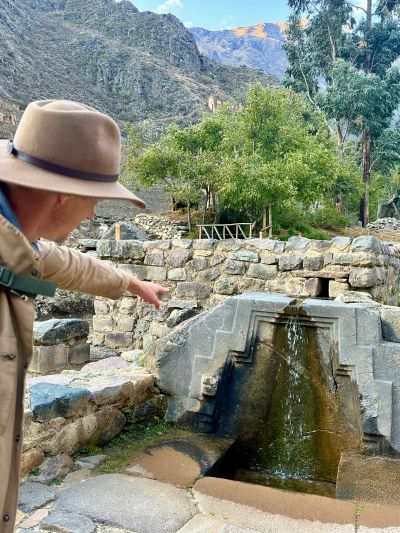
Peru — Ollantaytambo
Within the sacred complex of Ollantaytambo in Peru’s Sacred Valley, below the site’s monumental terraces and massive precision stonework, the Spring of the Ñusta is a finely carved ceremonial water feature located within the lower sector of the site.
Carved directly from stone with remarkable precision, the spring incorporates a prominent three-level stepped cosmogram arranged symmetrically around the central water channel.
Rather than appearing as decoration alone, the geometry is integrated directly into the hydraulic design, with sacred spring water deliberately flowing through its center.
Within the Ancient Code framework, this creates a dynamic relationship between the stepped physical structure and the movement of water through it, transforming the cosmogram into an enacted architectural process. The result is a striking union of geometry, water, landscape, and sacred function.
ACD Significance: Precision stone carving, sacred water architecture, three-level stepped cosmogram, flowing water integrated through the symbolic center, and one of the clearest examples of Ancient Code geometry expressed as an active architectural process.

Peru — Ñaupa Iglesia
Located in Peru’s Sacred Valley near Ollantaytambo, Ñaupa Iglesia combines remarkably precise rock-cut architecture with several symbolic forms found elsewhere in the region.
Its monolithic façade contains sharply formed internal angles, recessed surfaces, and distinctive geometric features carved directly into the stone.
Most significant is the relationship between the three-level stepped-pyramid form and the façade’s doorway-like recesses, which together evoke the Three Doors cosmogram.
Within the Ancient Code, the Three Doors represent the manifestation of physical reality through the celestial and underworld realms, bringing the three-tiered structure of the universe into a single architectural composition.
A remarkably similar relationship appears in the Kef Kalesi reliefs of the Lake Van region of Türkiye, where three-level stepped geometry and the Three Doors are likewise united within the same cosmographic system.
ACD Significance: Precision monolithic stonework, three-level stepped-pyramid geometry, the Three Doors cosmogram representing manifestation through the three-realm structure, and a striking architectural parallel with the Lake Van region.
Peru — Machu Picchu
High in Peru’s Andes, Machu Picchu integrates sophisticated stone architecture with an extraordinary relationship to the surrounding mountains and natural landscape.
Its precisely fitted masonry, carved bedrock, terraces, and monumental stonework appear inseparable from the environment.
Throughout the site, the Ancient Code appears through repeated three-door and three-window arrangements associated with the Three Doors cosmogram, representing the manifestation of physical reality through the Celestial and Underworld realms.
The site also preserves a distinctive Composite Pyramid form in which opposing stepped geometries are integrated into a single unified design. This composite form closely parallels the geometry beneath the central deity commonly associated with Viracocha on Tiwanaku’s Gate of the Sun.
Within the ACD, the Composite Pyramid represents the integration and harmonization of the Celestial, Physical, and Underworld realms into a unified whole, creating a powerful symbolic relationship between Machu Picchu and Tiwanaku.
ACD Significance: Precision stonework, Three Doors and three-window cosmograms, Composite Pyramid geometry, integration of the three realms, sacred landscape architecture, and a direct symbolic parallel with Tiwanaku.
Bolivia — Puma Punku & Tiwanaku
Near Lake Titicaca in Bolivia, Tiwanaku and Puma punku combine extraordinary precision stonework with one of the densest concentrations of Ancient Code symbolism in the Andes.
Their architecture includes enormous stone blocks and precisely shaped andesite elements, including the famous H-blocks, which form one of the clearest expressions of the H / Paired Pillars symbol within the ACD.
Other recurring forms include inverted pyramid, doorways, and inverted stepped-pyramid geometry associated with the metaphysical realms. Similar architectural relationships appear at the Kailasa Temple in India.
At Tiwanaku’s Gate of the Sun, the central figure commonly associated with Viracocha stands upon the Composite Pyramid while holding two condor-like figures in a balanced paired arrangement.
Within the Ancient Code, this reinforces the relationship between integration and the holding or maintaining of balance.
The same underlying geometry appears again at monumental scale in the ground plan of the Akapana Pyramid, creating a striking fractal relationship between symbol and architecture.
ACD Significance: Precision andesite stonework, prominent H-blocks, monumental doorways, inverted stepped-pyramid geometry, Viracocha’s paired holding configuration, the Composite Pyramid, and fractal repetition extending to the Akapana Pyramid.
Mexico — Mitla
In the Oaxaca Valley of southern Mexico, Mitla combines sophisticated stone construction with one of the richest concentrations of geometric symbolism in Mesoamerica.
Its precisely fitted façades, monumental lintels, and finely constructed mosaic panels form an extraordinary symbolic vocabulary.
Among the recurring designs are T forms associated within the ACD with balance, stepped-pyramid geometry, Chakana-like forms expressing the integration of opposing realms or states, and spiral or meander motifs associated with movement, cycles, expansion, and return.
In several compositions, these elements appear together within the same architectural language.
The combination strongly recalls symbolic relationships documented in the Andes, where stepped forms, balance symbolism, integrated geometries, and opposing movement likewise appear as parts of a larger cosmographic system.
ACD Significance: Precision stonework, T symbols and balance, stepped-pyramid geometry, Chakana-like integration, spiral movement and cyclical return, and multiple Ancient Code forms united within one architectural tradition.
Mexico — Uxmal
In the Yucatán Peninsula, Uxmal combines monumental Maya architecture with one of the clearest concentrations of recurring Ancient Code symbolism in Mesoamerica.
Its façades and ceremonial structures repeatedly integrate geometric symbolism directly into their design.
Among the most striking features are inverted T forms, three-level stepped-pyramid designs appearing both upright and inverted, and recurring spiral motifs.
Within the ACD, the inverted T represents balance within the metaphysical realms, while the opposing stepped forms express a relationship between manifested and metaphysical states.
The spirals introduce an additional principle of movement, expansion, and return within the same symbolic system.
Uxmal may also preserve a broader threefold emphasis.
The traditional rendering of its name as “thrice built,” considered alongside its repeated three-level geometry, adds an intriguing secondary layer to a site already rich in cosmographic symbolism.
ACD Significance: Inverted T symbols and metaphysical balance, upright and inverted stepped-pyramid geometry, spiral movement and return, threefold symbolism, and multiple Ancient Code relationships integrated within monumental Maya architecture.
United States — Three Rivers Petroglyph Site
Located in southern New Mexico, the Three Rivers Petroglyph Site preserves thousands of carved symbols created by ancestral peoples of the American Southwest.
Among them are striking examples of the three-level stepped-pyramid cosmogram, including an unusual form incorporating a central doorway or opening.
Within the Ancient Code framework, the stepped pyramid represents manifestation, while the addition of a central doorway transforms the symbol into a gateway of manifestation into the physical realm.
Related stepped geometry also appears throughout broader Pueblo and Hopi artistic traditions in petroglyphs, textiles, pottery, and other forms of traditional design, suggesting a persistent regional symbolic vocabulary.
While the historical relationship between these traditions and other ACD sites remains an open question, Three Rivers significantly expands the geographic distribution of one of the Ancient Code’s primary cosmograms and preserves an especially important doorway variant.
ACD Significance: Three-level stepped-pyramid cosmograms, gateway of manifestation symbolism, a rare stepped-pyramid-with-door form, and the extension of a primary Ancient Code symbol into the traditions of the American Southwest.
Spain — Menorca
Across Menorca in the western Mediterranean, prehistoric taulas form some of the largest freestanding T-shaped megaliths known from the ancient world.
Constructed from enormous upright stones supporting massive horizontal capstones, some reach approximately 5 meters (16 feet) in height.
Here, the T is not merely carved into architecture—it becomes the sacred monument itself, built from multi-ton blocks and positioned prominently within ceremonial complexes.
The same fundamental geometry appears thousands of miles away in the monumental T-pillars of Göbekli Tepe and at Çavuştepe, as well as within T-shaped architectural plans in Egypt.
ACD Significance: Monumental T-shaped architecture, multi-ton megalithic construction, ceremonial significance, and striking parallels with T forms in Türkiye and Egypt.
Italy — The Vatican
Within Vatican City, several prominent symbols provide an intriguing example of how ancient symbolic forms may have been preserved and reinterpreted within later sacred traditions.
Most notable is the monumental bronze pine cone known as the Pigna. Nearly four meters tall and dating to the Roman period, it was later incorporated into the Vatican complex.
The pine cone carries ancient associations with regeneration, immortality, and sacred life. Later Christian and Templar traditions also preserve cross pattée and solar-cross-like forms within the wider symbolic setting.
These cross forms bear a notable geometric resemblance to the ancient Solar Cross documented at Ayanis in the Lake Van region, raising the possibility that later traditions preserved or reinterpreted elements of an older symbolic vocabulary.
ACD Significance: Monumental pine-cone symbolism, cross pattée and solar-cross geometry, preservation of ancient symbols within later sacred traditions, and parallels with Ayanis.